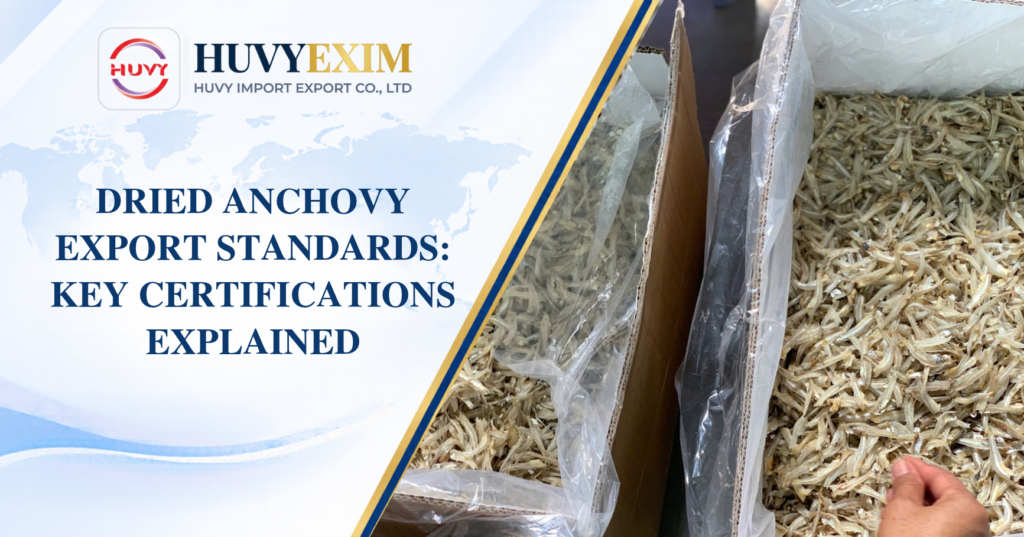
Successful international trade in dried anchovies depends on more than product quality alone. Buyers in Thailand, Malaysia, Singapore, and South Korea require clear proof that every shipment meets strict food safety and origin rules. In this article, HUVY EXIM explains the core dried anchovy export standards, including HACCP, ISO 22000, Certificate of Origin, and related certifications, that professional Vietnamese exporters follow to deliver fully compliant, documentation-ready cargo.
Why Certifications Define Dried Anchovy Export Standards
In bulk dried seafood trade, product specifications such as moisture (30% max), salt content (5–8%) and precise size grading are only part of the equation. Importers also need verifiable proof that the goods comply with international food safety systems and origin rules.
Certifications reduce the risk of customs delays, shipment rejection and downstream quality claims. They form the backbone of dried anchovy export standards and give buyers in key Asian markets the confidence to place regular container orders.
HACCP: The Foundation of Food Safety Control
HACCP is the core preventive system that controls food safety hazards throughout dried anchovy production and forms the baseline for export compliance.
What HACCP Means for Dried Anchovy Production
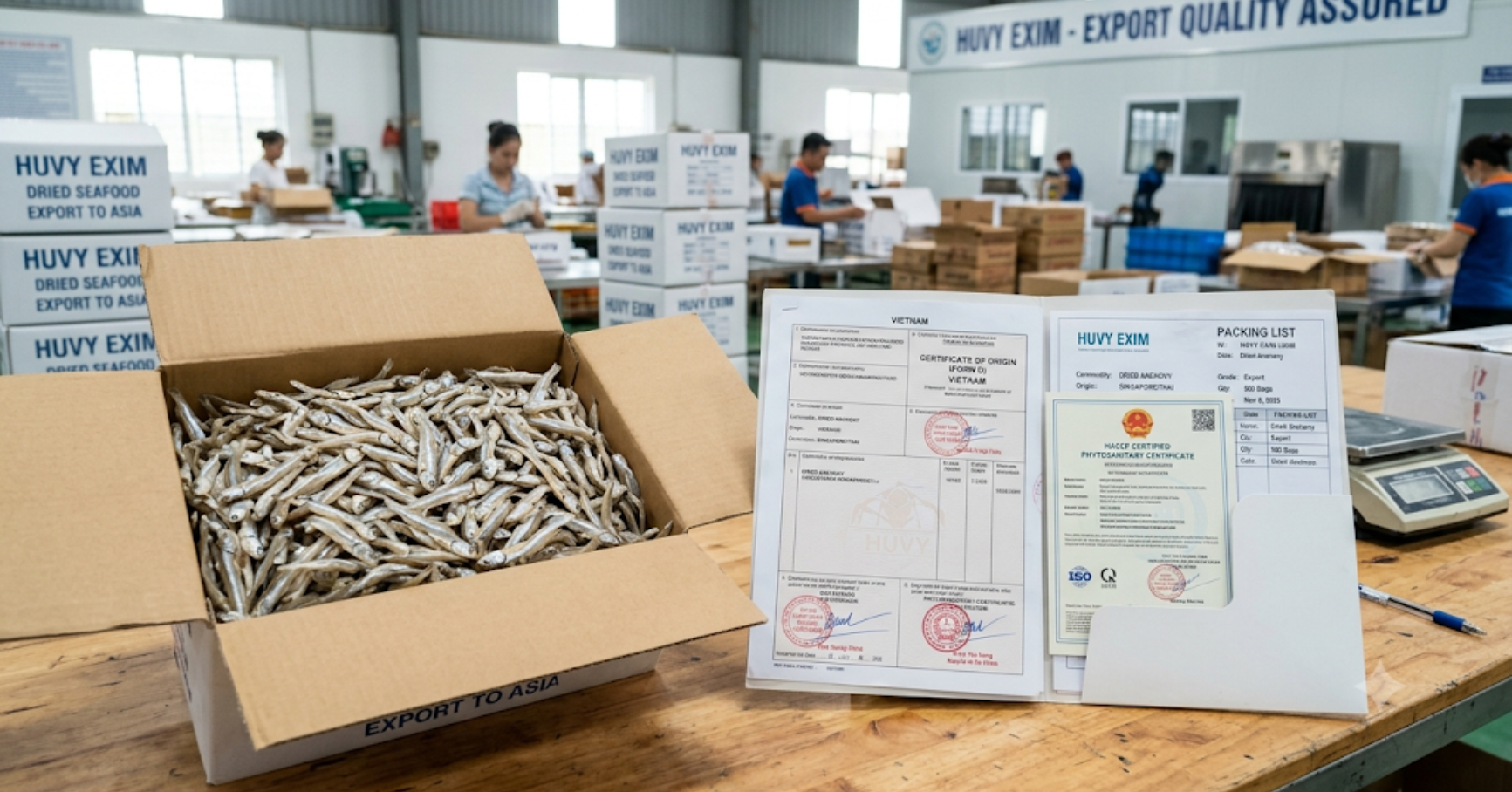
HACCP identifies and controls biological, chemical and physical hazards across every stage of production. For dried anchovies, key control points include raw material receiving, drying temperature and time, moisture verification, and packing hygiene. A proper HACCP plan ensures every batch meets safety limits before loading at Cat Lai Port.
Working with a HACCP Dried Fish Exporter
Choosing a HACCP-certified exporter gives importers documented proof of process control. Reputable suppliers maintain updated manuals, conduct internal audits and can provide certificates on request, helping shorten due diligence and speed up contract finalization.
ISO Standards for Consistent Quality Systems
ISO 22000 builds on HACCP to create a complete food safety management system, ensuring consistent processes from sourcing to final dispatch.
ISO 22000 in the Dried Seafood Supply Chain
ISO 22000 covers the entire chain, from sourcing to drying, grading, packing and dispatch. It ensures consistent control of moisture, salt content and size grading, along with full traceability and continuous improvement.
Choosing an ISO Dried Anchovy Factory
An ISO-certified factory offers higher system reliability. Quality procedures are embedded in documented processes rather than depending on individuals, making it especially valuable for long-term contracts and OEM programs.
Certificate of Origin: Proving Vietnamese Source
The Certificate of Origin confirms the goods are produced in Vietnam and enables preferential tariff treatment under Form D (ATIGA) or Form AK. In Vietnam, these certificates are issued by VCCI or the Ministry of Industry and Trade.
Form D (ATIGA) and Form AK Explained
- Form D (under ATIGA) enables preferential or zero-duty treatment for shipments to Thailand and other ASEAN markets.
- Form AK is used for South Korea and provides similar tariff benefits under the relevant trade agreement.
Accurate and timely issuance of these forms is an integral part of dried anchovy export standards and directly affects the landed cost for the importer.
Dried Anchovy Certificate of Origin Requirements
To obtain a valid Certificate of Origin, exporters submit supporting documents proving local processing and origin, typically the commercial invoice, packing list and production records. The certificate is then presented together with the Health Certificate, Phytosanitary Certificate and Bill of Lading for customs clearance.
FDA and Other Market-Specific Requirements
For the four core markets covered in this guide, HACCP, ISO 22000 and the correct Certificate of Origin remain the priority documents. FDA compliance is relevant only when targeting the US.
FDA Compliance for Dried Anchovy (If Targeting the US)
Some buyers ask about FDA requirements for the US market. These focus on facility registration, prior notice and compliance with US food safety rules, not a product-level approval. Most professional exporters already maintain HACCP and ISO systems that form a strong base for FDA compliance if needed.
Complementary Documents for Smooth Clearance
In addition to the core certifications, complete shipments usually include:
- Health Certificate
- Phytosanitary Certificate
- Halal certification (particularly important for Malaysia and Singapore)
- Full set of shipping documents (Bill of Lading, commercial invoice, packing list)
These documents work together to satisfy both food safety and customs requirements.
Market-by-Market Document Requirements
The table below summarizes the core documentation package for each main destination.
| MARKET | CORE DOCUMENTS |
| Thailand | HACCP, ISO 22000, Form D (ATIGA), Health Certificate, Phytosanitary Certificate |
| Malaysia | HACCP, ISO 22000, Form D, Halal (JAKIM), Health Certificate |
| Singapore | HACCP, ISO 22000, Form D, Halal (MUIS) if required |
| South Korea | HACCP, ISO 22000, Form AK, Health Certificate |
| US (optional) | FDA facility registration + prior notice |
How Professional Exporters Integrate These Standards
Reliable suppliers embed certification requirements into daily operations rather than treating them as last-minute paperwork. A typical flow includes:
- Traceable sourcing from approved fishing areas
- Controlled drying and laboratory verification of moisture and salt, following our five-step processing sequence
- Precision size grading
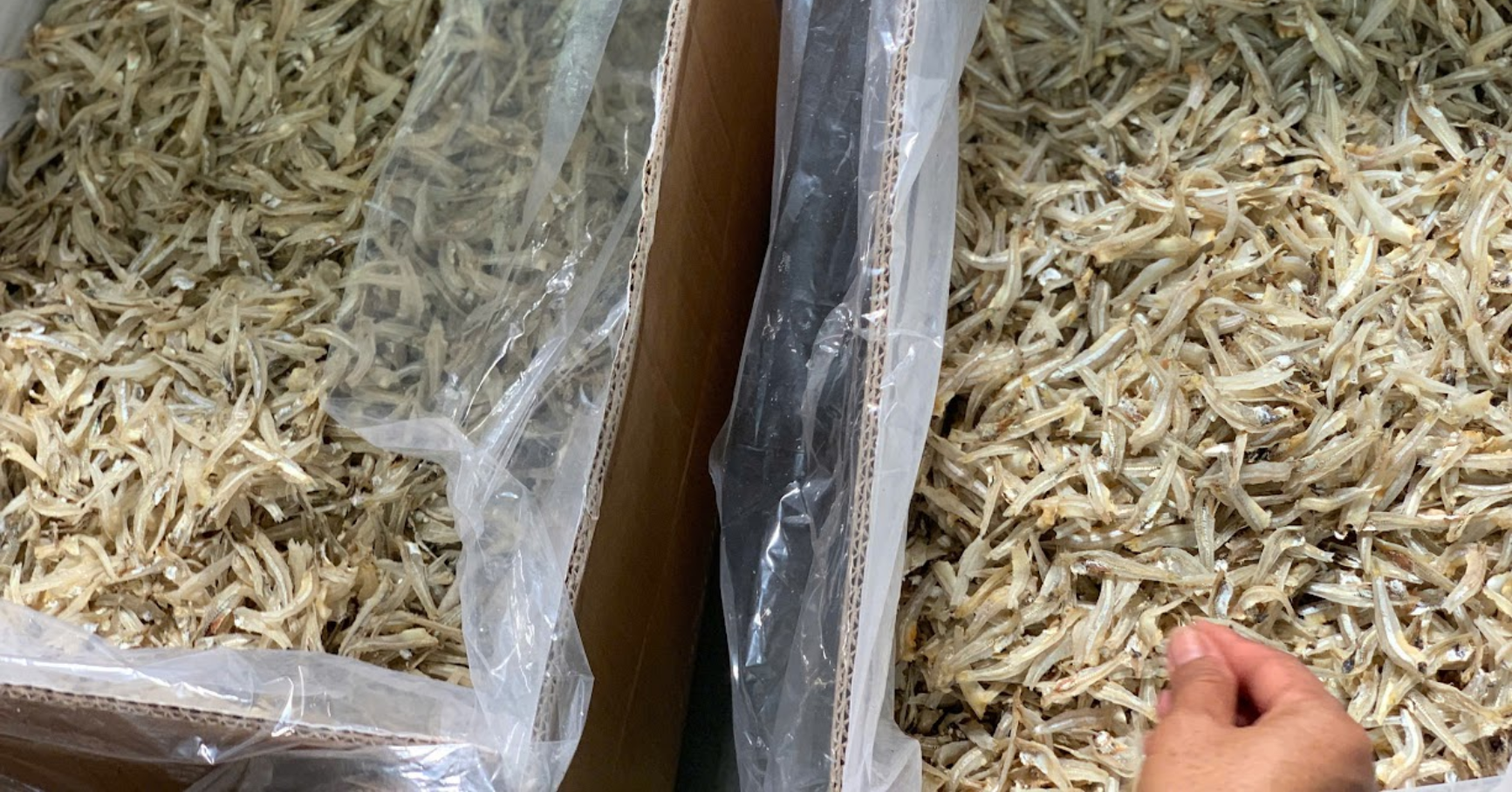
- Hygienic packing in 10–13 kg cartons (or customized formats)
- Issuance of the full documentation package before vessel departure
This integrated approach ensures that dried anchovy export standards are met consistently, shipment after shipment, and supports stable lead times of 10 days after contract confirmation as standard, with 5–10 days for stock and repeat orders.
Practical Checklist for Importers
When requesting a quotation or evaluating a new supplier, ask for:
- Current HACCP and ISO 22000 certificates
- Sample Certificate of Origin (Form D or Form AK)
- Recent laboratory reports for moisture and salt
- Confirmation of Halal status if required by your market
- Typical documentation lead time
Clear answers to these points quickly indicate whether the exporter can meet your compliance and logistics expectations.
Frequently Asked Questions About Dried Anchovy Export Standards
Importers often raise the same compliance questions during supplier due diligence. The answers below cover the points that most affect documentation, tariffs and clearance for dried anchovy shipments.
What is the difference between HACCP and ISO 22000?
HACCP is a preventive system focused on controlling food safety hazards at critical points. ISO 22000 builds on HACCP and adds a complete management system covering the entire chain, including traceability, documentation and continuous improvement.
Which Certificate of Origin applies to Thailand vs South Korea?
Shipments to Thailand and other ASEAN markets use Form D under ATIGA for preferential or zero-duty treatment. Shipments to South Korea use Form AK.
Is Halal certification mandatory for Malaysia?
For most food imports into Malaysia, Halal certification from a recognized body such as JAKIM is expected, particularly for retail and food-service channels. Singapore buyers typically request MUIS-recognized Halal status where applicable.
How long does the documentation package take?
Professional exporters typically issue the full documentation set before vessel departure, supporting lead times of 10 days after contract confirmation as standard, and 5–10 days for stock or repeat orders.
Does “FDA approval” apply to dried anchovy?
No. The FDA does not approve food products. Exporters targeting the US must register their facility, submit prior notice and comply with US food safety rules. HACCP and ISO 22000 systems provide a strong foundation for this.
Conclusion
Strong dried anchovy export standards rely on HACCP, ISO 22000, accurate Certificates of Origin and supporting food-safety documents. These elements protect product integrity, enable preferential tariffs and reduce risk for importers. For our full range of certified dried anchovy products, explore the category page.
For current certificates, technical specifications or a proforma invoice tailored to your discharge port, contact our trade desk. We are ready to support fully documented, compliant shipments.
Mr. Le Nguyen Quoc Hung
I am Le Nguyen Quoc Hung, the legal representative of HUVY IMPORT EXPORT COMPANY LIMITED (HUVYEXIM), a Vietnam-based import-export company. I am committed to developing reliable business relationships with international buyers, delivering export solutions tailored to our partners’ needs, and building long-term partnerships in global markets. Through HUVYEXIM, I aim to connect Vietnamese products with international markets while maintaining a strong focus on professionalism, product quality, and customer satisfaction.