
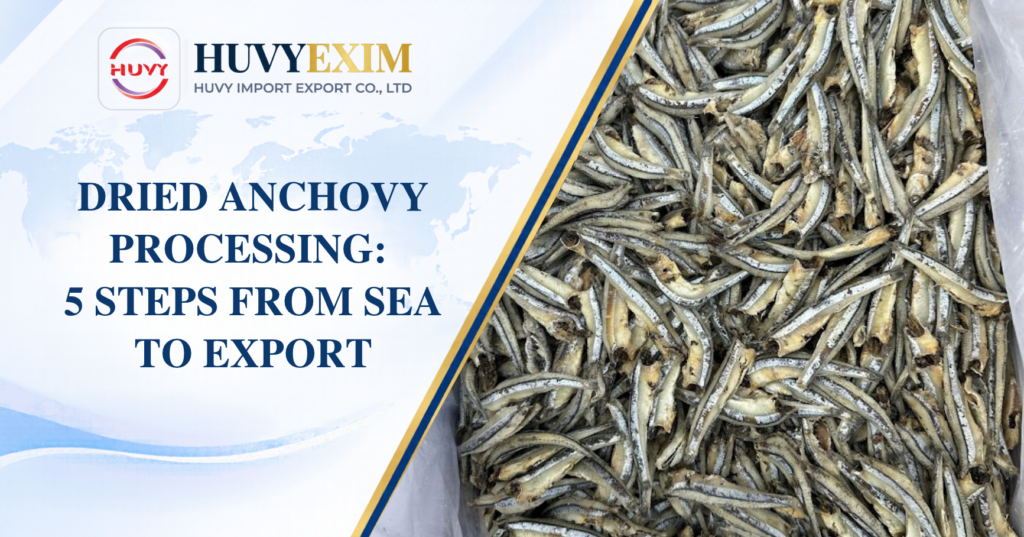
High-quality dried anchovies are the result of a controlled process that starts at sea and ends with laboratory-verified packing. In this article, HUVY EXIM explains each stage of professional dried anchovy processing—from catching and salting to sun-drying, mechanical dehydration, grading, and packing—used by leading Vietnamese exporters to meet international standards.
Why Understanding Dried Anchovy Processing Matters
For importers in Thailand, Malaysia, Singapore and South Korea, the quality of dried anchovies is never accidental. It results from a carefully managed sequence of steps that begin at sea and end with laboratory-verified packing.
Proper dried anchovy processing determines final moisture content (30% max), salt level (5–8%) and size consistency, which together define shelf stability and commercial value. When each stage is controlled under HACCP and ISO 22000 systems, buyers receive a predictable product suitable for both retail and industrial use.
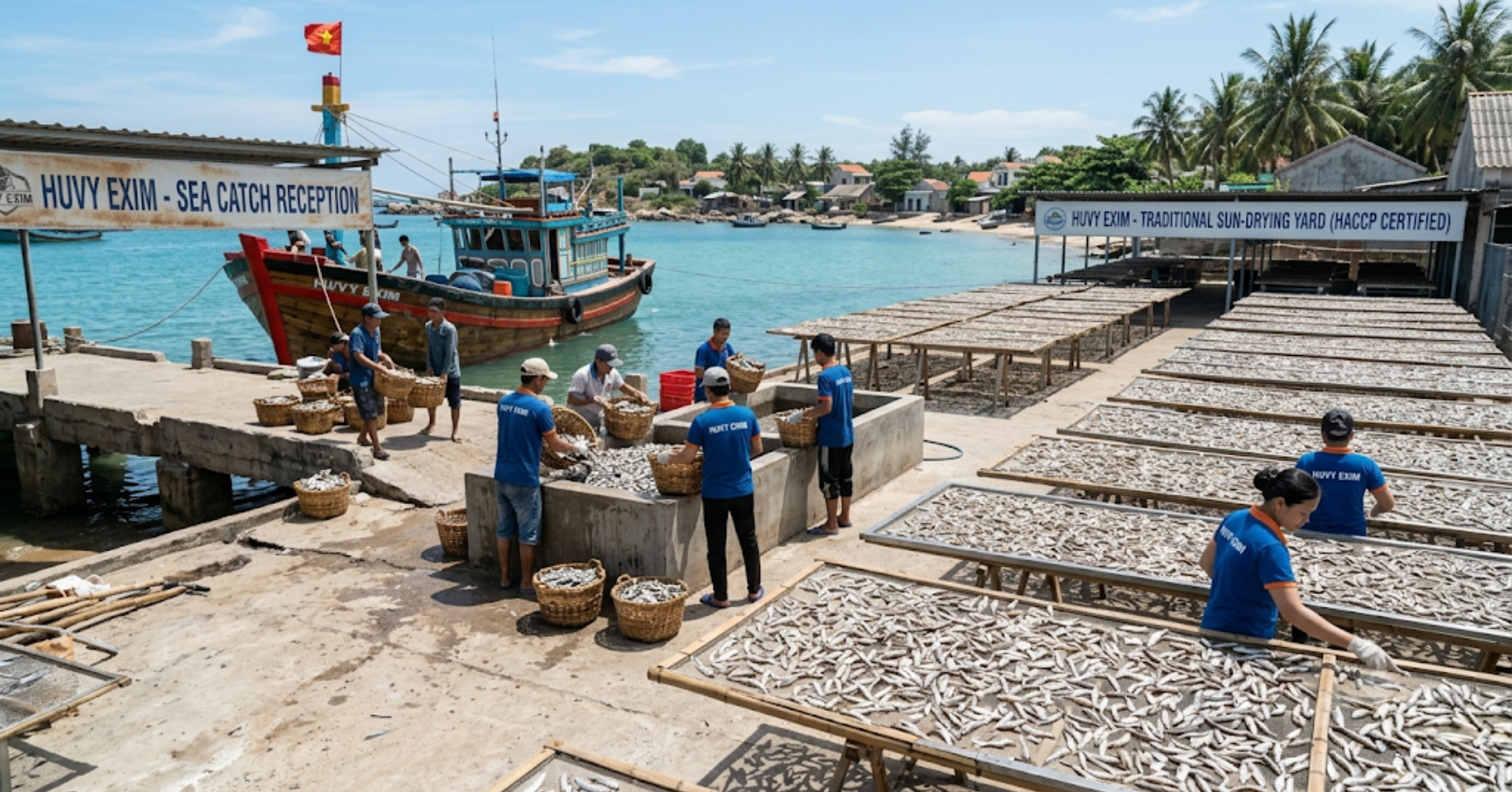
Step 1: Sea Catching & Raw Material Selection
Fresh anchovies are sourced from Vietnam’s coastal fishing fleets in Central and Southeast coastal waters, primarily Phú Yên, Bình Định, Khánh Hòa and Bà Rịa – Vũng Tàu. Only fish of suitable size and freshness are selected. Early selection is critical because the raw material directly influences the final commercial grades (1–2 cm, 2–3 cm, 4–6 cm and 5–7 cm).
Immediately after landing, the catch is sorted to remove damaged fish, by-catch and foreign matter. Clean handling at this stage protects product integrity and reduces quality risks later in the process.
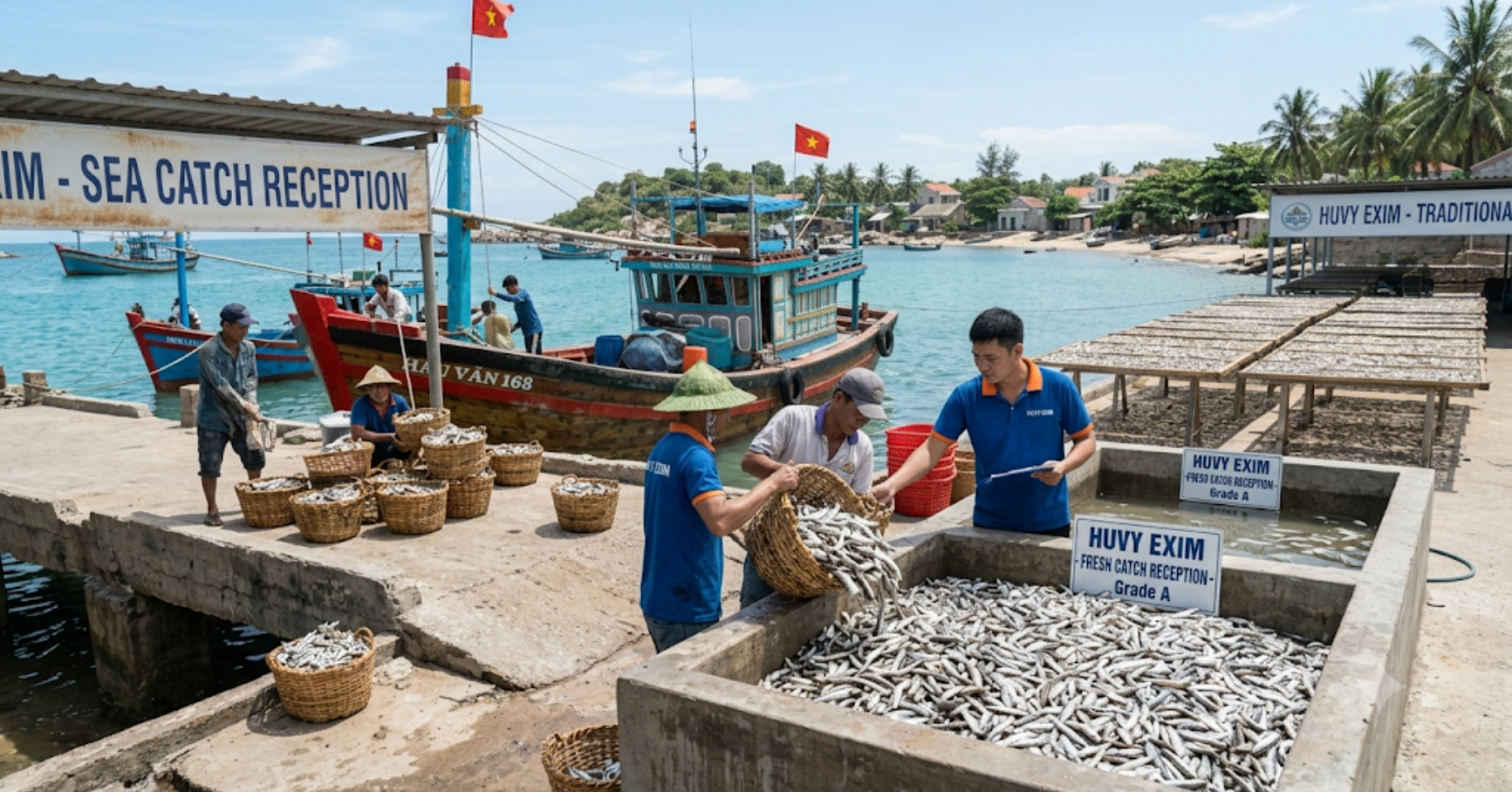
Step 2: Cleaning, Salting & Preparation
The selected fish are thoroughly washed in clean water. Depending on buyer requirements, the product may remain whole or be processed into headless or fillet forms.
The fish are briefly boiled in light brine to achieve a finished salt content of 5–8%. This step firms the flesh, sets the natural color and supports preservation without overpowering the product. This level enhances natural umami flavour and supports preservation without overpowering the product. After salting, the fish are prepared for drying.
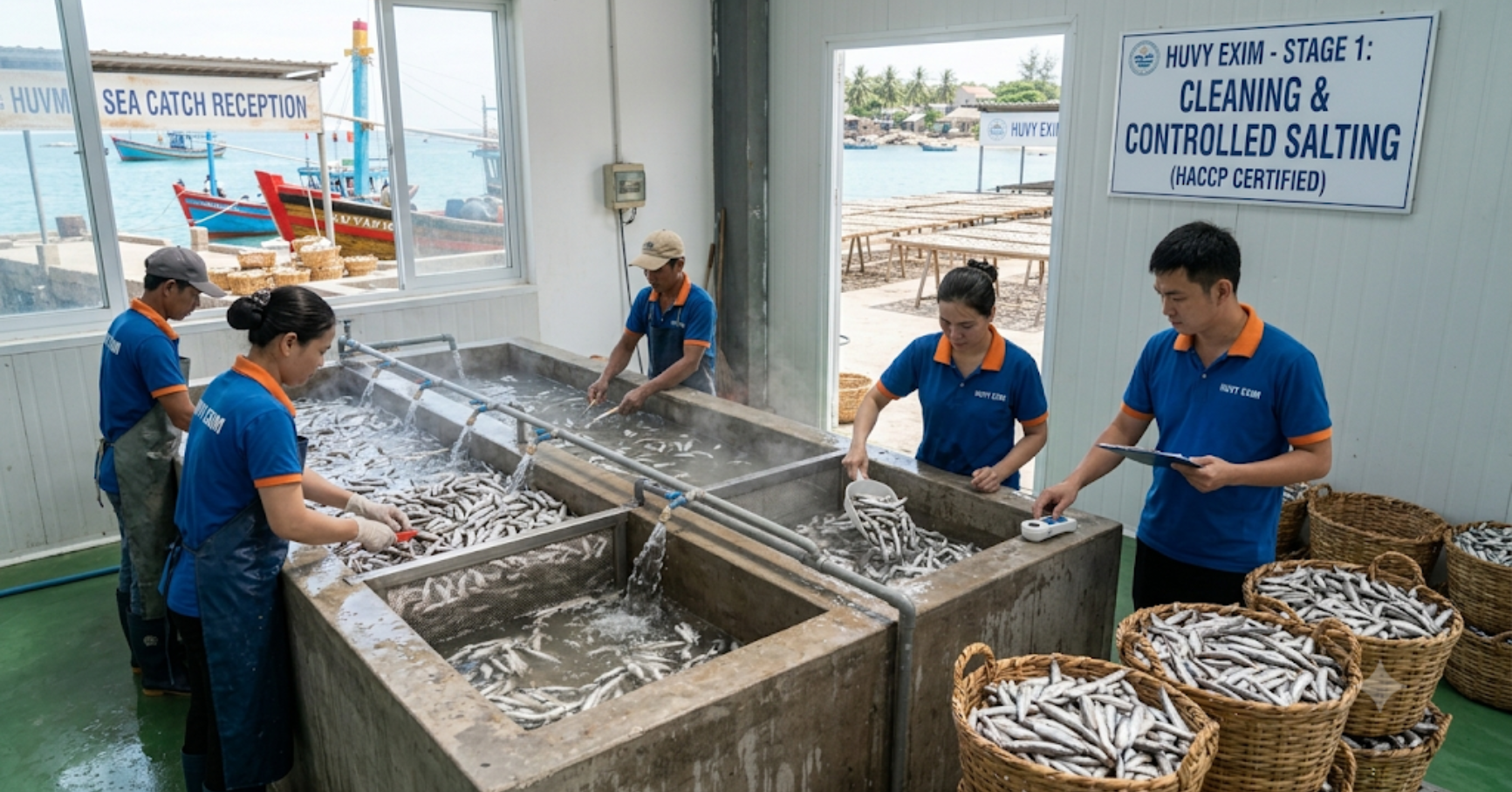
Step 3: Sun-Drying, the Traditional Core Process
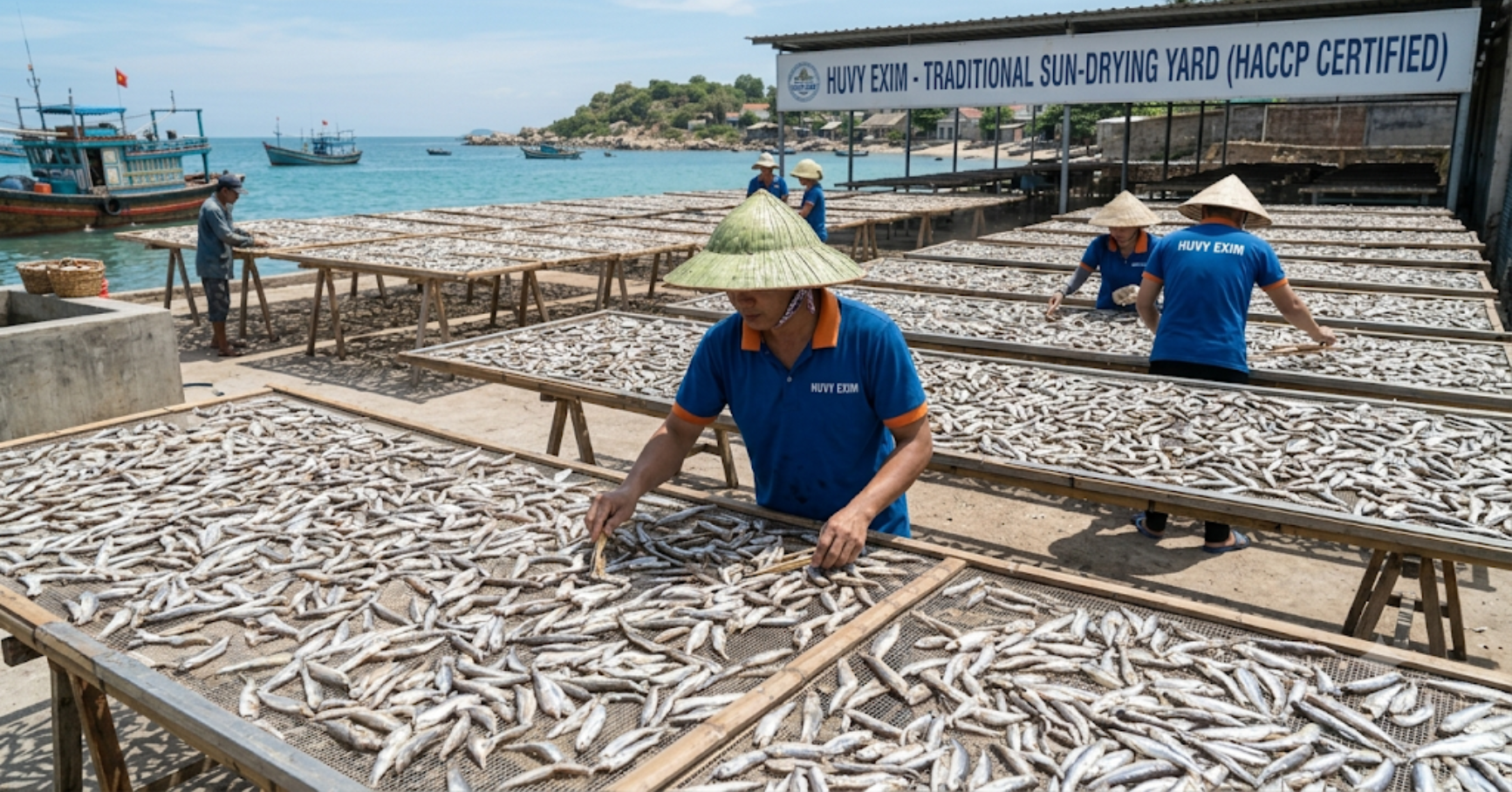
Sun-drying remains the traditional heart of dried anchovy production. The salted fish are spread on raised drying racks or clean yards under direct sunlight and turned regularly to ensure even moisture removal.
This natural method develops the characteristic flavour and appearance preferred by many Southeast Asian markets, and typically brings moisture down to roughly 40–50%. However, sun-drying is weather-dependent. Extended rainy periods can delay production and cause uneven results. Professional exporters therefore combine traditional sun-drying with modern controlled methods.
Step 4: Controlled Dehydration for Consistent Results
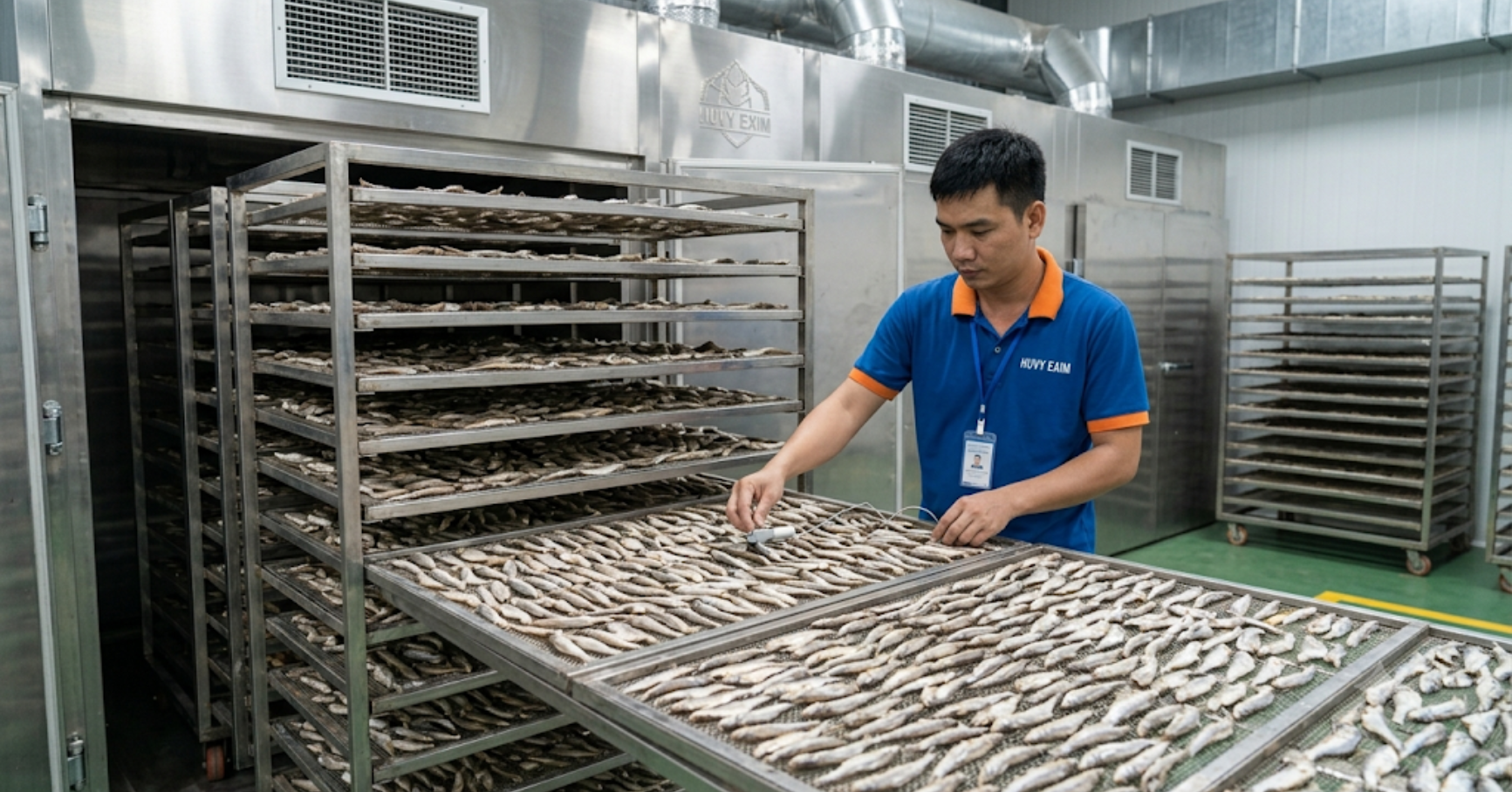
After initial sun-drying, many processors transfer the product to hygienic hot-air drying chambers. This step allows precise control of residual moisture, bringing the final level reliably down to the export standard of 30% max, and lower for premium lines where a firmer texture is required.
Mechanical dehydration reduces weather dependence, shortens processing time and delivers more uniform results across large batches. The most reliable producers use a hybrid approach: sun-drying for flavour development followed by controlled hot-air dehydration for moisture accuracy.
Step 5: Final Grading, Testing & Packing
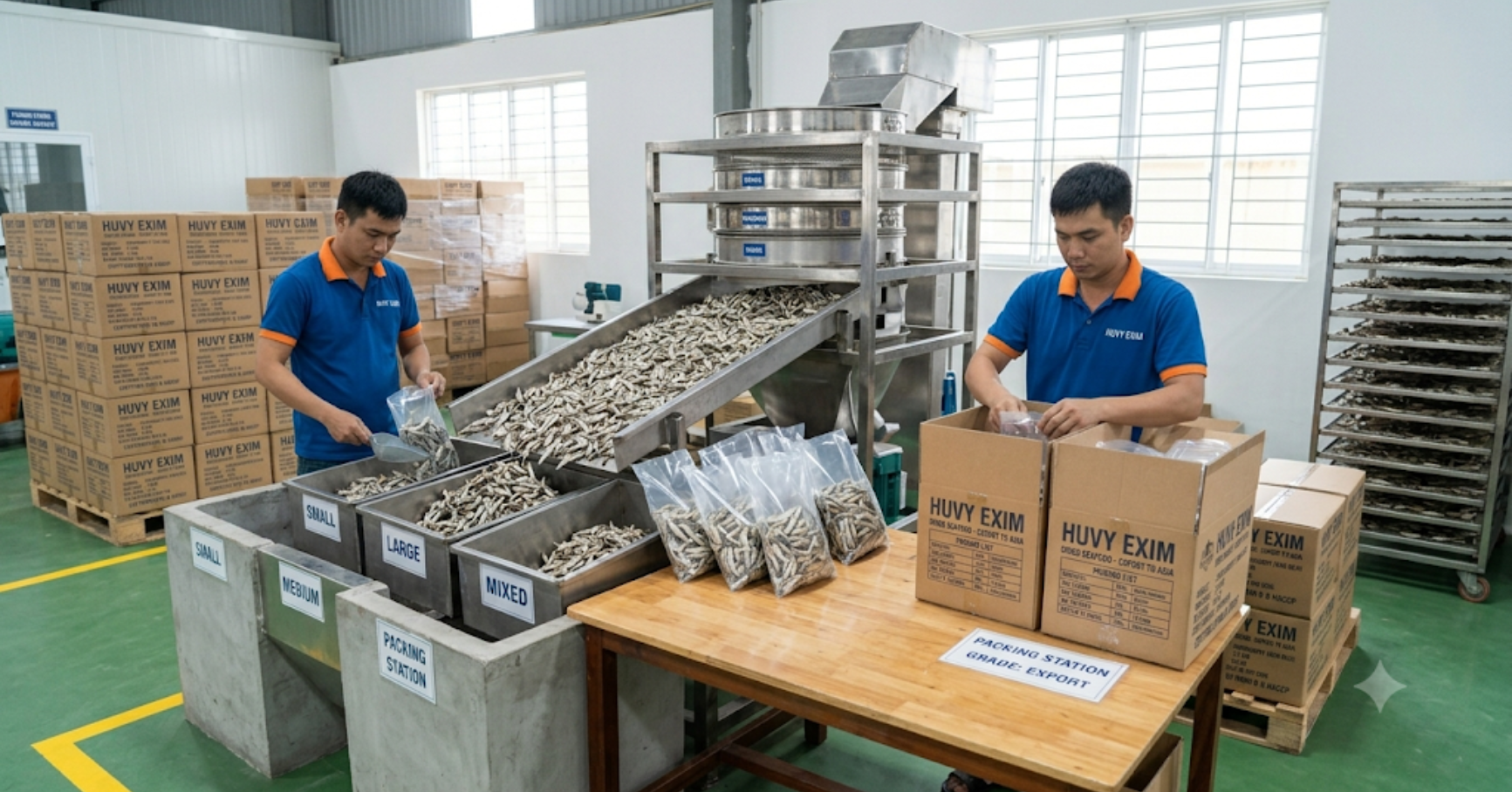
Once the target moisture is reached, the dried anchovies are graded by size into the commercial ranges: 1–2 cm, 2–3 cm, 4–6 cm and 5–7 cm. Colour sorting (white, grey or yellow) may also be performed according to market preference. Product-specific size bands vary by form, for example 3–4 cm and 3–5 cm for fillet, and 4–6 cm and 5–7 cm for headless.
Laboratory testing confirms moisture at or below 30% and salt content within 5–8% for standard grades, or within the agreed low-salt range for custom orders. Only batches that pass these checks proceed to packing. Standard export packing is 10–13 kg per carton, with custom formats available. MOQ is 6 MT, and monthly capacity typically supports 6–19 MT depending on grade and season.
Processing Summary at a Glance
| Step | Stage | Key control point |
| 1 | Sea catching & selection | Freshness, size, no by-catch |
| 2 | Cleaning & salting | Salt 5–8%, whole/headless/fillet |
| 3 | Sun-drying | Flavour development, moisture ~40–50% |
| 4 | Controlled dehydration | Moisture ≤ 30% (lab-verified) |
| 5 | Grading, testing & packing | Size 1–7 cm by form, 10–13 kg/carton |
How Quality Is Maintained Throughout the Process
Every stage of dried anchovy processing is monitored under HACCP principles and an ISO 22000 food-safety management system. Traceability records link each finished carton back to the original fishing area and production date.
This systematic control ensures the finished product consistently meets the technical specifications required for smooth customs clearance and reliable performance in the destination market. For the complete range of product forms, see our dried anchovy fish category.
Frequently Asked Questions About Dried Anchovy Processing
Importers often ask how each processing stage affects final quality and shelf life. The answers below cover the points that most influence product performance after sea transit.
Why is sun-drying still used if mechanical dehydration is more precise?
Sun-drying develops the characteristic flavour and texture that Southeast Asian buyers expect. Mechanical dehydration then fine-tunes moisture to the 30% max export standard. The hybrid approach combines traditional quality with modern consistency.
How does salting affect shelf life and taste?
Salt at 5–8% enhances natural umami and acts as a preservative. Levels closer to 5% suit snack applications, while levels near 8% provide extra stability for longer storage or further processing. Low-salt variants are available on request for specific markets.
Can processing be adjusted for headless or fillet products?
Yes. Cleaning and preparation can be adapted to whole, headless or fillet forms depending on buyer requirements, without changing the core drying and QC sequence. Size bands also vary by form, with headless and fillet lines typically requiring larger raw material.
What determines the final size grade?
Size grading depends on the raw material selected at Step 1 and is verified again at Step 5. Consistent grading protects pricing, packing density and end-use suitability for retail or food-service applications.
How long does processing take from catch to packed carton?
Processing time varies with weather and order volume, but professional exporters typically complete the full sequence and issue documentation within lead times of 10 days after contract confirmation as standard, and 5–10 days for stock or repeat orders.
Conclusion
Professional dried anchovy processing transforms a fresh coastal catch into a stable, export-ready product through controlled cleaning, salting, sun-drying, mechanical dehydration, grading and packing. When these steps are executed under documented food-safety systems, the result is consistent moisture (30% max), balanced salt content (5–8%) and accurate size grading.
For detailed process information, current technical specifications or a proforma invoice tailored to your discharge port, contact our trade desk today. We are ready to support fully documented shipments of high-quality dried anchovies to your market.

Mr. Le Nguyen Quoc Hung
I am Le Nguyen Quoc Hung, the legal representative of HUVY IMPORT EXPORT COMPANY LIMITED (HUVYEXIM), a Vietnam-based import-export company. I am committed to developing reliable business relationships with international buyers, delivering export solutions tailored to our partners’ needs, and building long-term partnerships in global markets. Through HUVYEXIM, I aim to connect Vietnamese products with international markets while maintaining a strong focus on professionalism, product quality, and customer satisfaction.